个人博客

废怯少女


  • Home
  • Archive
  • Search
  • Read
  • About
  • 中文ENIT

© 2026 Vesaluna

Theme Typography by Makito

Proudly published with Hexo

Notes | E041 and the sum of reciprocal squares

Posted at 2026-10-11 Notes Mathematics Euler 

AIAI-assisted translation·Read the source version

Today I read the first half of Euler’s E041, 『De summis serierum reciprocarum』. It was very interesting and does not require much mathematical background, though the English translated from the Latin original is rather convoluted and hard to follow.

My notes follow:

Let the radius of the circle be , the arc , , and . In the figure, first take ; then is the sine of the arc , and is its cosine.
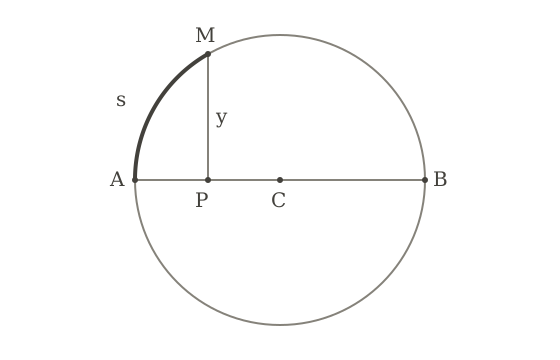
In the unit circle, PM is the sine and PC the cosine of arc AM

By Taylor’s formula,

From here on, I only use the expression for sine.

Usually we are given and find . Here we reverse the question and look for every arc length whose sine equals . There is more than one such .

First move everything to one side, then divide by so that the constant term becomes :

Treat the right-hand side as an infinite-degree expression in , and call all its roots .

Then, by analogy with finite polynomials, it could be factored into linear factors (although in general one cannot simply do this):

Now set , , , and so on. Expanding the first few factors helps reveal the pattern. With two factors,

With three factors,

So the coefficient of is ; that of is , the sum of products of pairs of distinct numbers; and that of is , where three distinct numbers are selected and the sign is negative.

Write

The coefficient of is on the left and on the right. There is no term on the left, so . For , the right-hand coefficient is and the left-hand one is ; hence .

First expand the square of :

and therefore

Let . Then

To find the sum of reciprocal squares, we only need .

Let be the smallest positive arc length whose sine equals , and write for the length of a semicircle. Within a period, and have the same sine. Adding or subtracting a whole revolution does not change it either. The roots thus form two sequences:

For example, taking successively, the first few terms can be written , , , , , and so on.

Now consider the special case .

Then , and .

Thus we have , , , and so on; each must be counted twice.

We found earlier that , so here .

Taking out the factor gives

Hence

This is the sum of the odd terms in the reciprocal-square series.

Let . The even terms can be written

The odd terms therefore sum to , and we obtain

Original text: Leonhard Euler, De summis serierum reciprocarum (E041).

 Next post: Notes | Speaking Like a Lady 

© 2026 Vesaluna

Theme Typography by Makito

Proudly published with Hexo